When imams tell you they are here to conquer, believe them.Iraq: Was Christian. Now 99% Muslim.
Syria: Was Christian. Now 93% Muslim.
Libya: Was Christian. Now 97% Muslim.
Egypt: Was Christian. Now 95% Muslim.
Sudan: Was Christian. Now 91% Muslim.
Jordan: Was Christian. Now 97% Muslim.
Turkey: Was Christian. Now 99% Muslim.
Algeria: Was Christian. Now 99% Muslim.
Lebanon: Was Christian. Now 61% Muslim.
Tunisia: Was Christian. Now 99.5% Muslim.
Morocco: Was Christian. Now 99% Muslim.
Albania: Was Christina. Now 50.7% Muslim.
Kosovo: Was Christian. Now 93.5% Muslim.
Palestinian territories: Was Christian. Now 98% Muslim.
Bosnia and Herzegovina: Was Christian. Now 51% Muslim.
Not just Christian. They conquer everyone:
Iran: Was Zoroastrian. Now 99.5% Muslim.
Malaysia: Was Hindu and Buddhist. Now 63.5–66%.
Indonesia: Was Hindu and Buddhist. Now 87% Muslim.
Pakistan: Was Hindu and Buddhist. Now 96.5% Muslim.
Bangladesh: Was Hindu and Buddhist. Now 91% Muslim.
Afghanistan: Was Zoroastrian and Buddhist. Now 99.7% Muslim.
Monday, August 31, 2026
Was Christian. Now Muslim.
Sunday, August 23, 2026
The Nonsectarian Ten Commandments
Actually, the Catholics, Protestants, and Jews all have different versions of the 10C, and the schools use a version specifically formulated to be nonsectarian, as explained here:
Shortly after the Second World War, a Minnesota judge named E. J. Ruegemer became concerned with what he perceived to be the rise of juvenile delinquency. He believed that “if troubled youths were exposed to one of mankind’s earliest and long-lasting codes of conduct, those youths might be less inclined to break the law.” He formed a committee “consisting of fellow judges, lawyers, various city officials, and clergy of several faiths” to develop a “version of the Ten Commandments which was not identifiable to any particular religious group.”DeMille went on to make the movie, The Ten Commandments (1956 film), and the monuments were used to promote the movie.Judge Ruegemer eventually partnered with Cecil B. DeMille and the Fraternal Order of Eagles to help place monuments inscribed with the Ten Commandments throughout the United States. When they were first erected in the mid-1950s, Protestants and Jews immediately pointed out that the numbering system was inconsistent with that used by their traditions.
Wednesday, August 05, 2026
Matthew 25 says the Rich get Richer
That chapter has The Parable of the Bags of Gold. That is where the master rewards the servants who invest his money, and punishes the one who buries gold in the ground.
26 “His master replied, ‘You wicked, lazy servant! So you knew that I harvest where I have not sown and gather where I have not scattered seed? 27 Well then, you should have put my money on deposit with the bankers, so that when I returned I would have received it back with interest.I read this as an endorsement of capitalism, not socialism. Investment is rewarded. It even says the rich get richer and the poor get poorer.28 “‘So take the bag of gold from him and give it to the one who has ten bags. 29 For whoever has will be given more, and they will have an abundance. Whoever does not have, even what they have will be taken from them. 30 And throw that worthless servant outside, into the darkness, where there will be weeping and gnashing of teeth.’
Sunday, July 26, 2026
How Wasta Destroys Islamic Nations
There are many reasons, and one of them is described in They Call It WASTA — And It’s Something That ALWAYS Destroys ISLAM:
Discover the hidden force quietly eroding Islamic nations from within. It's not war or sanctions, but a deep-seated system of favoritism and personal connections called Wasta. This unseen enemy turns ambition into frustration and potential into poverty, deciding who gets jobs and opportunities. Learn why this web of loyalty is far more destructive than traditional corruption, stifling innovation, fueling brain drain, and ultimately threatening the very stability of entire countries.
Wednesday, July 08, 2026
America was a Product of a Religious Enlightenment
American Revolution was a product of the religious enlightenment that occurred 20 years earlier.
The comment is a partial truth that's oversimplified and imprecise, but it gestures at a real historical dynamic. The American Revolution (1775–1783) drew on both Enlightenment rationalism and vibrant Protestant religious energies, which had been stirring in the colonies for decades. Calling it a "product of the religious enlightenment" 20 years earlier (roughly the 1750s–early 1760s) isn't standard terminology, but it captures something important about how religious revivalism and moderate Enlightenment ideas reinforced each other in America.
Was There a "Religious Enlightenment"?
Yes, in a broader sense. Historians like David Sorkin describe a "Religious Enlightenment" across Europe (and influencing America) in the 18th century: a moderate strand of Enlightenment thought that sought to reconcile reason, science, and religious faith rather than rejecting religion outright (as more radical French Enlightenment figures like Voltaire sometimes did). It emphasized "reasonable belief," religious tolerance, moral philosophy grounded in natural law, and personal piety over rigid dogma or hierarchy.
In the American colonies, this overlapped with (and was amplified by) the First Great Awakening (peaking 1730s–1740s, with effects continuing into the 1750s–1760s). Key figures included Jonathan Edwards and George Whitefield, who promoted emotional, personal conversion experiences, direct access to God (bypassing established clergy), and the idea that ordinary people could challenge authority. This wasn't purely "Enlightenment" (which stressed cool reason), but it shared themes of individualism, anti-hierarchical thinking, and questioning tradition.
The timing in the comment is off by a bit—the Awakening's height was 20–40 years before the Revolution—but its cultural ripples (new denominations, inter-colonial networks, empowered laity) were still fresh in the 1760s–1770s. The Stamp Act crisis (1765) and later events occurred against this backdrop.
Did It Make People More or Less Religious? Or a New View?
More religious in practice, with a new emphasis on personal experience: The Great Awakening was a revival that countered the perceived "deadness" of established churches. It increased church attendance in many areas, split congregations (Old Lights vs. New Lights), boosted evangelical groups like Baptists and Methodists, and fostered a more democratic, emotional style of faith. It made religion feel immediate and accessible rather than formal or inherited.
Not less religious overall: Unlike the more secular strains of the European Enlightenment, America's version didn't broadly erode faith. Many colonists blended Awakening-style piety with Enlightenment ideas. Religion remained central to daily life and politics.
A new view of religion: It promoted individualism ("priesthood of all believers" on steroids), skepticism of religious (and by extension political) authority, and the notion that liberty and virtue were divinely ordained. This "new view" was Protestant, often Calvinist-inflected, but open to reason and moral philosophy. Many Founding-era Americans saw rights as coming from God (or "Nature's God"), not kings or parliaments.
How Did This Influence the American Founding?
The Revolution and founding weren't purely secular or purely religious—they were a unique synthesis:
Religious fuel for resistance: Clergy (the "black-robed regiment") preached that resisting tyranny was a Christian duty, framing taxes and British policies as moral and providential issues. Biblical language (e.g., Exodus, liberty as God's gift) was everywhere in sermons and pamphlets. The Awakening built inter-colonial networks and a sense of shared identity that made coordinated rebellion easier.
Enlightenment ideas translated through religion: Thinkers like John Locke (natural rights, social contract) were filtered through a Protestant lens. Ideas of consent, equality before God/law, and republican virtue resonated because of the Awakening's democratizing effects. Many Founders (e.g., John Witherspoon, a Presbyterian minister and signer) embodied this blend.
Founders' own beliefs: Varied widely. Many were conventional Christians (e.g., Patrick Henry, Samuel Adams); others were Deists or liberal Christians influenced by Enlightenment reason (Franklin, Jefferson, Paine). Deism posited a distant Creator who endowed rights via reason/nature, without much emphasis on miracles or dogma. The founding documents reflect this: "endowed by their Creator" (Declaration) alongside no established national church and religious liberty (Constitution/First Amendment). This was pragmatic—avoiding Europe's religious wars while assuming a moral, religious citizenry.
Long-term impact: The synthesis supported religious disestablishment, tolerance, and the view that a free republic required virtuous (often religiously informed) citizens. It wasn't secularism as we might think of it today, nor theocracy.
Critique of the comment: It's insightful in rejecting a purely secular "Enlightenment = Revolution" narrative (a common oversimplification). Edmund Burke and others noted America's energetic Protestantism as key to its "free spirit." However, it overstates by calling it "the product" of a specific "religious enlightenment" 20 years prior—ignoring economic grievances, classical republicanism, English common law traditions, and the broader, ongoing interplay. The Awakening was more revivalist than "Enlightenment," and the causal link is contributory, not deterministic. Historians still debate the exact weight.
In short, the American founding succeeded partly because religious energies and Enlightenment reason mutually reinforced each other in a way that was distinctively colonial American. The comment gets the fusion right but simplifies the timeline and causality.
Monday, June 29, 2026
Blaming Christianity for the Fall of Rome
On Twitter, Grok often does fact checks, and posted:
@grok, If Christianity was a key driver, as supposed by Gibbon, why didn’t we see the same decline of civilization in the East? Why do modern historians criticise Gibbon’s take?The fall of Rome led to some setbacks, but Europe recovered to be far better than ever long before the Enlightenment of the 16th and 17th centuries.Gibbon claimed Christianity sapped Roman civic virtue and military spirit in the West. The Christian Eastern Empire (Byzantium) avoided that fate and endured another ~1,000 years, aided by stronger administration, Constantinople’s walls, and different geography/pressures—showing other factors mattered more for the West’s 476 collapse.
Modern historians fault Gibbon’s heavy emphasis on religion as Enlightenment bias. They see multifaceted causes (invasions, economic woes, plagues, overextension) and view Late Antiquity as gradual transformation with continuities, not religion-driven catastrophe.
The surprising thing is that the Roman Empire lasted as long as it did.
Update: New Lex Fridman podcast on Roman Empire.
Sunday, June 28, 2026
Atheists believe in Determinism
They argue that all of everyone's choices are determined by laws of nature, and yet they often talk about choices they make, and they try to persuade others to make better choices.
Here is a leftist-atheist-evolutionist in his latest of many rants against free will:
There need be no “free will” to have morality, for even though we lack free will, we are still malleable beings and can alter our behavior depending on society’s “moral code” and the praise and punishment that go with it.How can we alter our behavior if we have no free will? What is the use of praise or punishment, if no one else has free will either?
Since Egnor is a neuroscientist, the audience probably buys this the most. Egnor cites two bits of evidence here. First, as he says, during operations that involve stimulating parts of the brain, he says, “Patients asked to raise their arms at some point could tell whether they raised arm voluntarily or due to electrical stimulation.” And they could tell the difference. But that is not “free will”, ...There is a difference between raising your arm voluntarily, out of your own free will, and being forced to raise it because a brain surgeon triggered a neuron.
He complains that Egnor ignores a 2013 study that concludes:
Neuroscience cannot straightforwardly accommodate a concept of “conscious free will”, independent of brain activity [42].I accept that free will involves brain activity. I do not accept that there is any law of nature prohibiting free will.
They cite experiments by Libet that supposedly showed that voluntary decisions are preceded by brain activity. This means that a decision takes more than a millisecond, as the brain takes some time to make it. It has nothing to do with free will.
when you push a button at a time your brain determines, and think you did it of your own “free will.” The problem with that, and the reason Libet and his successors have done such provocative studies, is that brain signals (fMRI, etc.) say you’re about to push a button before you become conscious of making that decision.So your brain prepares to push the button before it pushes. It baffles me that anyone thinks this refutes free will.
Responses are posted here and here.
I have never said that people are or should be deemed “morally responsible” for their good and bad acts. That would assume the ability to freely choose to be moral or immoral, but I am a determinist who rejects that kind of “choice.” What I have said, and which anybody who reads what I’ve written will know, is that you should be held responsible for what you do, but not morally responsible. That is, you are responsible if you are the person who performed the act. That, to anyone with two neurons to rub together, is absolutely compatible with determinism.So no one can make any moral choices. Curiously, he goes into a big rant against another site for plagiarism. Web content is mostly generated by robots today, and of course the robots are deterministic plagiarizers.
If no one has any free will, then all the humans posting online are just deterministic automatons who are not much different from the robot plagiarizers that he complains about. Including himself.
He concludes, to rousing applause, that “Free will is God’s fingerprint in us.”I wonder if that is the real issue. Catholics and most other Christians believe in free will, and Atheists believe in determinism. Rejecting free will is a way of expressing rejection of Christianity. The other prominent anti-free-will scholars are all strident Atheists. They like to present themselves and logical, scientific, and enlightened, but what they say does not make any sense, is not grounded in science, and is terrible advice on how to live.Here we see that religion, tricked out in the trappings of science, has led Egnor to reject determinism and materialism because they don’t involve his Catholic God.
Sunday, June 21, 2026
Canada is Burning Christian Churches
At least 33 Canadian churches have burned to the ground since May 2021. So far, 24 are confirmed arsonsMore on Wikipedia.CBC investigation finds steep rise in church fires since reports of potential graves at residential schools ...
"I don't think white people came here and burned this down."
The arson was triggered by a story about gravesites that turned out to be a hoax.
Sunday, June 14, 2026
How a Vatican II Statement Favored the Jews
Other religions also believe themselves to be better.
A shift occurred in the 1960s when this teaching was considered bigoted, or anti-semitic, or insufficiently tolerant. A church official even said:
[37:37] The Christian churches no longer wanted to convert the Jews. While they may not be sure of the theological grounds that dispensed them from that mission, the churches have become aware that asking Jews to become Christian is a spiritual way of blotting out their existence and thus only reinforces the effects of the Holocaust.This podcast goes into detail on how this spokesman was actually a gay Jew, Gregory Baum, who had infiltrated the Church. Somehow he got Vatican II to issue a statement favorable to the Jews.
Occasionally I hear of Jews making demands on the Catholic Church, as if the Pope's job is to get the Jews a free pass into Heaven.
Wednesday, May 20, 2026
Myth of the Islamic Golden Age
Winston Marshall refutes this in this interview. He says that Islam expanded by force, not by trade, and by subjugating Christians, Jews, and others. The supposed great accomplishments under Islam were really from non-Moslems whose culture contined under Islamic rule. Eventually Islam completely took over in those countries, and that golden age ended.
Spain/Portugal was the exception, as there the Christians eventually expelled the Moslems. Spain and Portugal then became great naval empires.
Saturday, May 02, 2026
Hate Group Attacks Christian Republicans
The findings of this report document a sustained, escalating, and coordinated campaign of hate and bigotry against Muslim Americans by Republican elected officials, amplified through social media. What began with a single gubernatorial repost in February 2025 has grown, within thirteen months, into an operation involving 89 Republican elected officials, including 86 members of Congress across three reinforcing tracks: 1,111 social media posts by 46 elected officials, eight pieces of legislation across both chambers of Congress, and a formal congressional caucus with 62 members. This represents an unprecedented level of coordinated anti-Muslim bigotry by elected officials in the U.S.No, this was not started by a single post a year ago. Christians wised up to Mohammedans trying to kill them about 1300 years ago.
They want to equate Christianity with bigotry. Christians do not agree with Islam for a lot of very good reasons.
Thursday, April 16, 2026
The Attacks on Christian Identity Politics
Here is a Wash. Post article (mirror, mirror) attacking such Christians, by its religion editor:
The unreligious religiosity of Christian identity politics ...What is the real gripe here? Catholics have always been much more numerous than evangelicals. Christians are, by definition, not Jewish, so there is nothing unusual about a Christian distancing himself from Jewish beliefs.Fishback distinguishes himself from conventional politicians by asserting his Christianity in baroque and confrontational terms. He does not just invoke Christian themes. He draws a line between Christians and non-Christians, as in his comment about the Western Wall.
Fishback’s religious rhetoric is part of an emerging form of Christian identity politics. Like a number of prominent influencers, he interlaces elaborate expressions of Christian piety with criticisms of Jewish supporters of Israel. Many of these influencers are “trad Caths,” Catholics drawn to the traditional Latin mass and alienated from the church hierarchy. They are creating a religious right distinct from the one that was once led by evangelicals.
Sometimes these articles complain about Christians rejecting Dispensationalism:
Dispensationalism is a Christian theological framework for interpreting the Christian Bible which maintains that history is divided into multiple ages called dispensations in which God interacts with his chosen people in different ways.[1]: 19 It is often distinguished from covenant theology, the traditional Reformed view of reading the Bible.[2][3] These are two competing frameworks of biblical theology that attempt to explain overall continuity in the Bible.This is some obscure theology. Most Christians have never even heard of it. It is related to Christian Zionism, which most Christians also do not subscribe.
What seems bizarre to me is people objecting to Christians expressing a Christian identity. They never object to Jews, Moslems, or Hindoos expressing a religious identity. So why the attacks on Christians?
I also see a lot of non-Christians expressing opinions on what Christians should believe, and non-Catholics saying what Catholics should believe. Typically they have their own idiosynchratic Bible interpretations. Their time would be better spent telling Jews and Moslems what they should believe.
Sunday, April 05, 2026
Judge Declares Christians Believe in Truth
Today, the Texas A&M Journal of Law Civil Governance published a very timely conversation between Judge Kacsmaryk and the 2023 Jurist of the Year, Judge James C. Ho. It is titled, "What Does It Mean To Be A Christian On The Bench?" ...Some non-Christians questioned whether Christians believe in truth, so I asked an AI LLM.Judge Kacsmaryk had this to say about textualism ... "This is where the faithful Christian should have a Textualist advantage: we believe there is such a thing as objective, external, knowable Truth."
Yes, Judge Matthew Kacsmaryk is correct in his characterization of what many (and arguably most traditional or "faithful") Christians believe. The quote comes from a recent speech or remarks titled "What Does It Mean To Be A Christian On The Bench?" where he argues that a Christian worldview provides an advantage in textualist statutory interpretation because it orients the interpreter toward seeking an objective, external, knowable truth (in this case, the "ordinary public meaning" of legal text at enactment, rather than subjective or evolving interpretations).
Core Christian Belief on Truth
Christianity, across its historic branches (Catholic, Orthodox, Protestant, Evangelical), has long affirmed that truth is objective, external to the human mind, and in principle knowable. This stems from several foundational ideas:
God as the source of truth: The Bible portrays God as truth itself (e.g., "I am the way, the truth, and the life" in John 14:6; God "cannot lie" in Titus 1:2 or Hebrews 6:18). Truth isn't invented by humans or cultures but reflects God's nature and the reality He created.
Objective reality: Creation is orderly and real, independent of our opinions (Psalm 19:1-4; Romans 1:20 — general revelation through nature). Moral and spiritual truths are likewise grounded in God's character and commands, not personal preference.
Knowability: Humans, made in God's image, can apprehend truth through reason, observation, conscience, and especially special revelation in Scripture (which is seen as inspired, authoritative, and propositional truth — 2 Timothy 3:16-17). While sin and finitude can cloud understanding, truth is not inherently inaccessible or purely subjective.
Correspondence view of truth: Something is true if it corresponds to reality as it actually is. This contrasts with relativism (truth is whatever feels right to the individual or group) or postmodern skepticism (truth claims are power plays with no objective anchor).
This view directly opposes Pilate's skeptical "What is truth?" (John 18:38), which Kacsmaryk references. Christians historically reject the idea that truth is fluid, constructed, or unknowable; they see it as fixed and discoverable, even if imperfectly grasped by fallen people.
Variations Among Christians
Not every self-identified Christian holds this view with equal rigor today:
Traditional/orthodox Christians (evangelicals, conservatives in other traditions) strongly affirm objective truth. Apologists and theologians routinely contrast it with cultural relativism, arguing that denying objective truth undermines morality, the gospel claims ("Christ is the only way"), and even coherent reasoning. Surveys sometimes show gaps among younger churchgoers, but the doctrinal stance of historic creeds and confessions is clear.
Liberal or progressive Christians may lean more toward experiential, contextual, or metaphorical understandings of truth, emphasizing love, justice, or personal encounter over propositional absolutes. Some embrace elements of postmodern thought. However, even here, claims about God, ethics, or Jesus often retain an implicit claim to objective validity ("this is what Christianity truly is").
Catholic tradition adds natural law and magisterial teaching as reliable guides to objective moral and theological truth.
Protestant emphasis often highlights sola scriptura — Scripture as the external, objective standard.
Overall, Kacsmaryk's "we" refers to "faithful" Christians who take core doctrines seriously. This belief has been a through-line in Christian thought from the early church fathers through Aquinas, the Reformers, and modern apologists. It isn't unique to Christianity (many theistic religions and classical philosophy affirm objective truth), but it fits naturally with a Creator who reveals Himself reliably.
Relevance to Textualism
Kacsmaryk's broader point is that if you already believe in objective truth (rather than seeing interpretation as endless deconstruction or personal projection), you're better equipped to pursue the fixed public meaning of a legal text without injecting modern preferences. Whether that gives Christians a practical "advantage" in judging is debatable — plenty of non-Christian textualists (e.g., Justice Scalia, who was influenced by but not defined by his Catholicism) succeed by the same logic. But the underlying premise about Christian belief holds.
In short: Yes, he is correct. Faithful Christians do believe there is objective, external, knowable truth — rooted in God, reality, and revelation. This has been a consistent teaching, even as cultural pressures toward relativism challenge it.
Saturday, April 04, 2026
Happy Easter from Trump, not from England King
Here is Pres. Trump's Easter message:
This Easter Sunday, the First Lady and I join with Christians all across our Nation and around the world in rejoicing in the Resurrection of Jesus Christ, whose triumph over sin and victory over death secured the promise of redemption and the hope of eternal life for all who believe in Him as Lord and Savior.A Jewish paper reports:Sunday, we proclaim with joy that Christ has risen, a new creation has been ushered in, and evil and death have been conquered forever through the unmatched power of God’s sacrificial love.
When Jesus Christ rose from His earthly tomb on Easter morning, He restored our grace, washed our sins, and reconciled humanity with God—fulfilling the ancient prophecy that “He was pierced for our sins, crushed for our iniquity … by His wounds we were healed.” His suffering won our victory, His love brings us life, and His Resurrection is our everlasting hope.
As we rejoice in this Easter season, we are reminded that the life of Jesus Christ and the truths of the Gospel have inspired our way of life and our national identity for 250 years. From the Christian patriots who won and secured our liberty on the battlefield and every generation since, the love of Christ has unfailingly guided our Nation through calm waters and dark storms.
We pray that this celebration of the Resurrection strengthens our faith, enriches our lives, and reawakens our souls. We offer prayers of adoration and thanksgiving for the countless blessings God has bestowed upon our Nation. We acknowledge that, through Christ’s redeeming sacrifice, in the words of Holy Scripture, “Death is swallowed up in victory.” Above all, we echo with tremendous joy those sacred words that have given life, hope, and purpose to Christians for thousands of years: He is risen.
Happy Easter!
Photos of the new king wearing his royal kippah, facts about his circumcision and his relationship with rabbis abound. ...The London Telegraph says: How the King became the Jewish community’s greatest ally. There is no surer way to show that you are symbolically owned by the Jews -- get circumcized by a rabbi.There is much to tout in terms of the new king’s devotion to Judaism. Another delightful photo is of him donning his kippah, which was first sighted at the installation of Britain’s current Chief Rabbi Ephraim Mervis in 2013. Charles was the first member of the royal family to attend an installation of a chief rabbi. ...
King Charles III, along with thousands of British Jews, was circumcised by Rabbi Jacob Snowman, a physician and one of London’s leading mohelim, or ritual circumcisers. The queen requested Snowman, who was well known in the London community.
Update: The new Archbishop of Canterbury is pro-LGBT feminist Sarah Mullally. A third of the bishops are now women. She was born in Woking.
Wednesday, April 01, 2026
Bill Maher believes in Space Aliens
Last week he gave a tv monologue on how he now believes that we are being visited by space aliens.
If at this point you don’t believe aliens are here and observing us, maybe you’re the conspiracy theorist. They're here, they came in a sphere, get used to it.The evidence is some of the new UFO/UAP videos that have been released.
Yes, I think a space alien invasion is as ridiculous as the religions he mocks.
Separately, Physicist Sabine Hossenfelder says We pretty much have evidence for life in other solar systems. This is based on finding signatures of non-equilibrium compounds in alien planet atmospheres.
Maybe Maher is just making a joke. Some comments:
It’s clear that Maher, like me, doesn’t believe that these aliens and their craft really exist. He’s just using the notion to criticize what’s wrong with America. If craft and aliens did exist, and we possess crashed ships and alien bodies, then somehow there has been a massive conspiracy to hide it by both Democratic and Republican governments—as well as by the press— to cover up the greatest news story in the history of humanity.(The first comment was retracted here.)[reply] Bill Maher genuinely seems to believe in aliens—he’s not just entertaining the idea. He appears to be as convinced of their existence as he is that COVID originated from a lab leak. He has interviewed the creator of the documentary Disclosure twice — once on Real Time and once on Club Random — and was very supportive in both conversations. In a previous Overtime segment, he was also asked about Area 51 and suggested that the government is hiding evidence of extraterrestrial life. In my personal opinion Maher has been smoking too much weed.
I am coming around to a view where it is meaningless to talk about what others believe it. I cannot judge Maher's sincerity, nor can I be sure whether he is joking. And I don't think it makes a difference.
Nor can I say whether Pres. Trump believes in God, or whether Richard Dawkins is really an atheist. It is much better to judge people based on their actions.
Lots of people have weird beliefs. I am inclined to think that if someone has some very wacky belief, like space alien visitors, then all his other opinions should be discounted. But this leaves me discounting everyone.
Another example of this is free will. Many educated people say they do not believe in free will. To me, that reduces them to a mindless automaton, or to a schizophrenic following voices in his head. When they give opinions while denying free will, they are literally saying that the opinions are not their own. But it is also possible that they believe in free will, and only deny it because of some defect in their mental logic.
Tuesday, March 31, 2026
Canada Schools Teach Paganism
In the early 2000s, I spent much of my time over the course of several years fighting the incursion of religion into science classes in the United States. ...Actually the judge did not write it. The ACLU wrote it, and the judge rubber-stamped it. The decision relied on the Lemon Test, which has since been reversed by the US Supreme Court. The judgment no longer has value.We were very successful, culminating in a famous court case in Dover, Pennsylvania, where a local school board had tried to replace a high school science text with an intelligent design textbook. After testimony from numerous scientists, the judge wrote a remarkable 139-page judgement describing ID as religion, rather than science, and therefore not appropriate for discussion in high school science classes.
You may wonder how religious fundamentalism could so effectively creep into the curriculum in a progressive place like British Columbia. The answer is simple. The religious nonsense being inserted into the curriculum has nothing to do with Christian fundamentalism; rather, it is Indigenous religious nonsense. And in the current climate, Indigenous “knowledge” is held to a different standard from scientific knowledge — or, rather, to no standard at all.The Catholic Church and the other mainstream Christian churches teach regular science, and not the stuff he complains about.The B.C. Curriculum resorts to a phrase that was utilised by the New Zealand government when they too distorted the high school science curriculum in that country by arguing that Indigenous “Ways of Knowing” should be taught alongside conventional science and treated as an equally valid way of understanding how the world works.
Thursday, March 26, 2026
Tucker Carlson Accused of Heresy
The supposed heresy is Marcionism, an ancient obscure dispute about what books should be included in the Bible. Marcion like Paul, but not the Old Testament.
It is amusing to see political attention to old theological disputes. Apparently National Review sees its mission as policing right-wingers, and stopping them from annoying the Jews.
Carlson has become anti-war, much to the annoyance of Pres. Trump and pro-Israel factions. But I do not see that he said anything supporting Marcionism.
Carlson is simply taking the mainstream Christian view that the Gospels supersede the Old Testament. He disagrees with those who say Christianity is subordinate to Judaism.
Friday, February 27, 2026
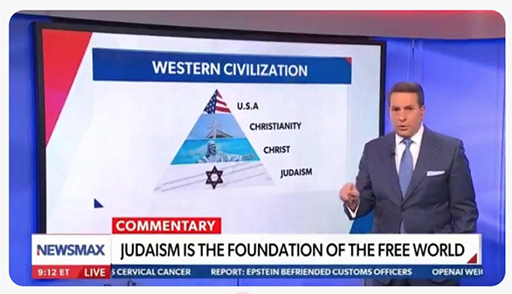
The USA was not Founded on Judaism
If this were a Jew, I would say it is understandable that someone thinks that his religion is more important than others. But it is almost certainly a Christian Zionist, as no Jew would make this diagram.
You might say the USA was founded on Christianity, as well as the Roman Empire, Greek philosophy, English Magna Carta and common law, and many other European influences. But not Judaism. The founders paid no attention to Judaism, except to reject it. Even Israel gets its political system from Britain, not Judaism.
Here is Mike Huckabee defending Christian Zionism, and attacking his Tucker Carlson interview. He defines it as following Jesus and also believe the Jews have been brought to their homeland in fulfillment of Scripture. He claims that recent Catholic Popes have been Christian Zionists.
I asked an AI LLM if he is correct:
No, Mike Huckabee's recent claim that several recent Catholic Popes were **Christian Zionists** is not accurate. Christian Zionism is a theological and political viewpoint primarily associated with evangelical Protestantism (especially in the U.S.), which interprets biblical prophecies as requiring support for the modern State of Israel as a fulfillment of God's promises to the Jewish people, often tied to end-times eschatology. It typically affirms that the Jewish people have a divine right to the land, sometimes extending to expansive biblical borders.The bizarre thing to me is that Huckabee seems to not even understand why a Christian would not be a Zionist. Here is a hint: Christianity and Judaism are two different religions.The Catholic Church, including under recent Popes like John Paul II, Benedict XVI, and Francis, has explicitly rejected a theological basis for Zionism—that is, the idea that the modern State of Israel fulfills biblical prophecy or that Jews have a divine scriptural right to exclusive sovereignty over the Holy Land. The Church views the ancient covenants with the Jewish people as irrevocable (per Romans 11 and Vatican II's Nostra Aetate), affirms the Jewish people's enduring bond with God, and supports Israel's right to exist securely as a modern state on political and humanitarian grounds (e.g., self-determination, safety from antisemitism). However, this is not rooted in Christian Zionist theology.
Recent Popes have:
- Supported a two-state solution for Israel and Palestine.
- Recognized both Israel (diplomatic relations in 1993 under John Paul II) and Palestine (agreements in 2000 and 2015 under John Paul II and Francis).
- Advocated for justice, peace, and reconciliation for all in the region, including Palestinian Christians.The heads of churches in the Holy Land (including Catholic leaders) have repeatedly condemned Christian Zionism as a "damaging ideology" that harms Christian unity and the local Christian presence, as in statements from 2006 and January 2026.
Huckabee, as a self-described Christian Zionist and U.S. Ambassador to Israel, made statements in January 2026 defending the term and questioning why any Christian wouldn't be a Zionist, in response to those church leaders' criticisms. He has expressed bewilderment that not all Christians share this view, but this reflects his evangelical perspective, not Catholic teaching.
Your impression that Catholics historically wanted the Holy Land for Christians aligns with pre-20th-century views (e.g., during the Crusades or earlier papal opposition to Zionism, partly due to concerns over holy sites and Christian communities). But modern Catholic policy prioritizes peace, dialogue, protection of holy places for all faiths, and rights for Palestinians (including Christians) alongside Israel's security—without endorsing Christian Zionist theology.
In short, while recent Popes have supported Israel's existence and condemned antisemitism, they are not Christian Zionists in the sense Huckabee uses the term. The claim appears to be an overreach or misunderstanding from a Protestant evangelical viewpoint.
He is the USA ambassador to Israel. Most Americans are pro-Israel, but do not buy into his theology.
An orthodox Jew law professor has posted another rant on how Catholics must not be permitted to say that Jews killed Jesus or to reject Zionism. He says the Catholic faith has been corrupted by the world's oldest hatred. No, this is crazy anti-Christian hatred. Jews like to tell stories about how they are supposedly being persecuted. They are not. Jews are the most privileged people in the world.
I see that Jews have just outbid Netflix to buy Warner Bros. Discovery. This keeps more of the mainstream media under Jewish control. See this video, if you doubt that the buyers are loyal to Israel.
Wednesday, February 25, 2026
Carlson Questions Christian Zionist
Most mainstream Christian Catholics and Protestants regard Christian Zionism as a heresy.
Matters of ancestry are usually settled by DNA, but DNA tests are illegal in Israel, with certain exceptions, such as court orders and medical screening. DNA tests can used to help prove that a Jew is entitled to Israel citizenship. Regular consumer DNA tests are illegal, as in Germany and France. They are cheap and legal in the rest of the world.
It baffles me how the people of those three countries can put up with such a ban. Everyone should have a right to know who he is. DNA gives identifying info that cannot be obtained in any other way.
In France and Germany, the purpose of the ban is to cover up a mother's infidelity. In Israel, the ban is also to cover up many Jews not really having Jewish ancestry.
Update: The UK BBC tries to explain Carlson:6:52 Well, the thing that Tucker, and he did this at Fox, too. Um he's he's doing this still. He he's very good at taking fringe ideas, ideas that exist on the far far far far right often times, you know, on the internet. Um, taking those ideas and smuggling them into the mainstream and presenting them in such a way he makes them more palatable. ...Not far far far far right. An obvious fact.the 7:22 most sort of famous instance of this is the great replacement theory. this idea that um elites, oftentimes Jews, are bringing immigrants into the United States to replace white voters and therefore support the Democratic party. I mean, this is this is a theory that has been bumping around on the far far far right for for decades.
Sunday, February 22, 2026
New CNN Special on Christian Nationalism
The Whole Story with Anderson Cooper, a six-time Emmy® Award-winning CNN Original, returns with “The Rise of Christian Nationalism” with CNN Anchor and Chief Investigative Correspondent Pamela Brown premiering Sunday, February 22 at 8pm ET/PT. The hour will stream on demand the next day for subscribers of CNN’s streaming offering.Good. It defines the term. It is not an attempt to radically change American government, but to affirm its history.In this hour, Brown examines the growing influence of Christian nationalism, an ideology rooted in the belief that the United States was founded as a Christian nation and that its laws and institutions should reflect Christian values.
Many Trump administration actions have blurred the lines between church and state. In the days before Kirk was assassinated at Utah Valley University, Trump delivered a speech at the privately funded Museum of the Bible in Washington, DC, where he promised to protect prayer in public schools through forthcoming guidance from the Department of Education.A federal court just upheld a Louisiana law requiring the display of the Ten Commandments in the schools.“To have a great nation, you have to have religion,” Trump said. “I believe that so strongly. There has to be something after we go through all of this — and that something is God.”
Plaintiffs present no historical evidence that remotely suggests that our Founders would have regarded a passive display of the Ten Commandments as an impermissible “establishment of religion.” ...Those founders did not necessarily agree about their religious views, but they all believed in Christian education.Plaintiffs present no historical evidence that remotely suggests that our Founders would have regarded a passive display of the Ten Commandments as an impermissible “establishment of religion.” U.S. Const. amend I. See, e.g., Kennedy, 597 U.S. at 537 & n.5 (noting the “hallmarks of religious establishments the framers sought to prohibit when they adopted the First Amendment”) (citing, inter alia, Shurtleff v. City of Boston, 596 U.S. 243, 285–86 (2022) (Gorsuch, J., concurring)). To the contrary, our Nation’s history proves precisely the opposite.
Our Nation’s Founders didn’t just permit religion in education — they presumed that there would be religion in education. Indeed, our Founders firmly believed that our Constitution wouldn’t work without a religious people.
John Adams famously observed that “[o]ur Constitution was made only for a moral and religious People. It is wholly inadequate to the government of any other.” John Adams, Letter to the Massachusetts Militia (Oct. 11, 1798). John Jay similarly wrote that “Providence has been pleased to give this one connected country, to one united people, . . . professing the same religion, attached to the same principles of government.” The Federalist No. 2, at 9 (John Jay) (J. Cooke ed. 1961). The Massachusetts Declaration of Rights, contained in the 1780 Massachusetts Constitution, proclaimed that “the happiness of a people, and the good order and preservation of civil government, essentially depend upon piety, religion and morality.” Mass. Const. pt. I, art. III.
Given the centrality of religion in our Founders’ conception of good citizenship, it’s not surprising that religion was a cornerstone of American education from the beginning. The First Congress understood religious instruction to be a necessary element of education, providing in the Northwest Ordinance of 1789 that “[r]eligion, morality, and knowledge, being necessary to good government and the happiness of mankind, schools and the means of education shall forever be encouraged.” 1 Stat. 50, 52 (1789).1