
I found this on Twitter. I do not know how accurate it is. Common claims about wealth concentration may be wrong.
I found this on Twitter. I do not know how accurate it is. Common claims about wealth concentration may be wrong.
Yes, there is a well-established "natural" scaling law—rooted in the Pareto distribution (a power-law distribution)—that describes the number of millionaires, billionaires, and ultra-wealthy individuals in market economies.
This isn't a rigid deterministic rule but an emergent statistical pattern observed across many economies and historical periods. It arises from multiplicative processes in wealth accumulation (e.g., returns on capital, networks, innovation, and "rich-get-richer" dynamics), where small advantages compound over time. See Wikipedia.
This pattern appears in firm sizes, city populations, and other complex systems with preferential attachment or multiplicative noise—common in free-market settings where success breeds further success (e.g., via capital compounding, talent clustering, or winner-take-most markets).
In short, market economies naturally generate power-law wealth distributions, which predictably determine how many cross millionaire or billionaire thresholds as the economy scales. This has been modeled and observed for over a century. For deeper dives, look into works by Pareto, Piketty/Jones on top wealth dynamics, or empirical power-law studies of billionaire data.

I found this on Twitter.
This view is widespread, but I have criticized it many times. It is anti-Christian propaganda. Most of what created the modern world was invented during the period labeled the Christian Dark Ages on this chart. Christian Europe advanced centuries ahead of the rest of the world.
The chart gives the impression that Europe would have done better without Christianity, or that Europe was falling behind the rest of the world. Not true. The opposite is more accurate.
It is true that when the Roman Empire moved east, some areas got left behind. But Christians were playing the long game, and making changes that would take centuries to pay off.
Everyone agrees that scientific advancement skyrocketed in Christendom after about 1500, while the rest of the world lagged far behind. That built on earlier advances, such as those described in Renaissance of the 12th century.
I get the impression that a lot of educated people think that Christianity somehow held back scientific progress, and that we might have advanced farther without it. That is completely crazy, as all Christian countries did much better than all non-Christian countries. The difference is so dramatic that it is hard to imagine Christendom doing better than it did.
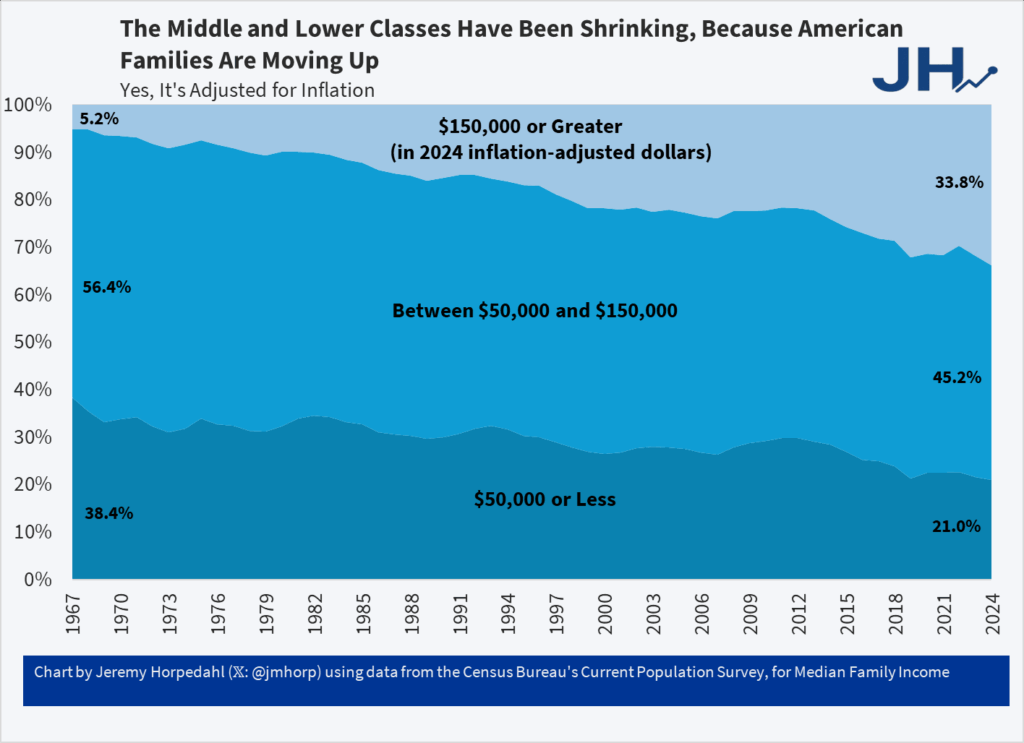
People complain about the shrinking AMerican middle class, as if that were a bad thing, but look at this graph; Note that the figures are inflation adjusted, and they are for household income, not individual income.
We do have more two-earner households.
Making $150,000 a year is wealthy. You can live in a nice house, drive fancy cars, eat high-class food, and go on exotic vacations.
This wealthy sector went from 5% to 34%. So a third of American households are rich.
Britain's net public debt has climbed from 35% of GDP in 2005 to 95% today. The government is borrowing over 4% of GDP annually despite no emergency comparable to the financial crisis or pandemic that drove much of the earlier increase. The belt-tightening needed to stabilize debt levels amounts to about 2% of GDP. The Labour government holds a 157-seat majority in Parliament and has four years until the next election.This tracks Britain importing millions of non-whites.Britain spends about 6% of GDP supporting pensioners, an increase of over a third this century. Some 15% of the working-age population now claims jobless allowances following a surge in disability claims since the pandemic. Labour attempted to reduce spending on pensioners and welfare this year but reversed both reform plans after political outcry from within the party.
Brexit does not seem to have mattered much directly. Many voted for Brexit in the hopes that it would slow the foreign invasion. Just the opposite. Importing low-IQ high-crime foreigners accelerated.
Freedoms are declining. Besides paying more taxes, Britains are routinely being jailed for expressing online opinions. Some have even been arrested for saying silent prayers.
Public Health “Experts” Want To Legitimize This Barbaric Practice In The Name Of MulticulturalismHe shows British immigrants with birth defects from genetic diseases, and how British public health authorities approve. Meanwhile, Connecticut is banning cousin marriage.43,514 views Premiered 4 hours ago The Matt Walsh Show Today on the Matt Walsh Show, the so-called public health experts in the UK have decided that actually maybe incest isn’t so bad after all. Welcoming the third world through mass migration means welcoming third world practices. This is just the latest example. ...
2:19 It would be extraordinarily timeconsuming, if not impossible, to even attempt to list all the ways that Public Health “Experts” Want To Legitimize This Barbaric Practice In The Name Of Multiculturalism 2:25 Christianity is responsible for the creation and development of Western civilization as we know it. Christianity 2:31 is why the West is literate. It's why we had the industrial revolution. It's why we have a functioning legal system. All 2:38 of these achievements of course trace to many different individual causes, contributions of many individual 2:44 Christian nations, leaders, monasteries, universities, the Crusades and so on. 2:51 But there was one Christian innovation that all by itself had a direct observable and enduring impact on the 2:58 trajectory of Western civilization. And while this particular innovation isn't discussed very much, or at least it 3:04 hasn't been discussed very much in recent history because we haven't had to discuss it. Um, well, that's about to 3:09 change. I'm talking about the Catholic Church's decision around the sixth century to ban marriages between first 3:16 cousins. And once the church banned first cousin marriages in the Middle Ages along with marriages among step 3:23 relatives, in-laws, and godparents, the West began rapidly pulling ahead of the 3:29 rest of the world. And make no mistake about it, the church's influence was indeed the primary reason why Europeans 3:34 stopped marrying their relatives. The other major religions were expressly endorsing all kinds of incestuous 3:41 relationships. And this the statistics bear this out.
Federal Reserve governor Lisa Cook urged the Supreme Court Thursday to reject President Trump’s effort to fire her, arguing it would harm central bank independence and disrupt financial markets.Really? Pres. Biden appointed Cook because she is a Black woman. She wrote some dopey academic on African colonialism, or some such nonsense, and had no banking expertise. Maybe Biden somehow confirmed that she would do what the Jews want.“Granting the President’s request for immediate relief to alter the status quo would sound the death knell for the central-bank independence that has helped make the United States’ economy the strongest in the world,” Cook’s lawyers argued in a new filing. ...
Cook's lawyers also make the argument that if the Supreme Court sides with Trump, it could have “dire repercussions” for financial markets while risking "chaos and disruption."
The idea that our economy depends on the employment stability of an appointed Black woman banker is absurd.
The Federal Reserve Bank as a whole has been a big failure for a century. Academic research indicate the USA would have been better off without it.
The argument is often made that these bankers should be sheltered from public accountability. The best evidence for this is that Latin American dictators have sometimes used central banks to manipulate the money supply unfavorably. Yes, that's right, but I think the USA is better than that.
The other argument is that Jews have controlled the Federal Reserve Bank for the last few decades, and Jews are good with money if we do not watch them too closely. Jews have a reputation for moneylending that goes back centuries. Okay, I am sure Jews do make better bankers than Black women.
Trump's Secretary of the Treasury is not Jewish but he is gay. Maybe that is just as good.
It is funny to see Kamala Harris say in her book that she did not pick the previous gay cabinet secretary because he is gay, and then try to deny it:
Buttigieg “would have been an ideal partner — if I were a straight white man,” but he was “too big of a risk,” Harris continued.The real problem with Buttigieg is not that he is gay, but that Blacks hate him.Maddow, who is gay, pushed Harris to “elaborate,” adding: “To say that he couldn’t be on the ticket effectively because he was gay, it’s hard to hear.”
Harris quickly jumped in.
“No, no, no, that’s not what I said, that he couldn’t be on the ticket because he is gay,” the former vice president said as she shook her head.
“My point is, as I write in the book, is that I was clear that in 107 days, in one of the most hotly contested elections for president of the United States against someone like Donald Trump, who knows no floor — to be a black woman running for president of United States and as a vice presidential running mate a gay man, with the stakes being so high — it made me very sad. But I also realized it would be a real risk,” she continued.
A month ago, I set out to answer a deceptively simple question: Is AI a bubble?All these new technologies have boom and bust phases, so AI will surely become a bubble and crash.Gauge 1 – Economic strain: Is investment now large enough to bend the economy?
Gauge 2 – Industry strain: Are industry revenues commensurate with the deployed capex?
Gauge 3 – Revenue growth: Is revenue rising/broadening fast enough to catch up?
Gauge 4 – Valuation heat: How hot are valuations? Compared to history, are stocks excessively overpriced?
Gauge 5 – Funding quality: What kind of money is funding this? Is it strong balance sheets, or fragile, flighty capital?
The article makes a convincing argument that we are not there yet.
Here is a new Stanford study:
First, we find substantial declines in employment for early-career workers in occupations most exposed to AI, such as software development and customer support.It is worse in Canada:• Second, we show that economy-wide employment continues to grow, but employment growth for young workers has been stagnant.
• Third, entry-level employment has declined in applications of AI that automate work, with muted effects for those that augment it.
Canada's tech job market has gone from boom to bust in a matter of years, a new study says.Canada has been radically importing Third World workers, and now they are being replaced by AI.
I believe that AI really is transforming the economy, but mostly in ways that are difficult to measure. Millions of jobs will be replaced or eliminated.
As the article says, this was in 2020, when the whole world went crazy over George Floyd.
Cook writes that "free speech has its limits" and should not be used to "spread hatred and violate the dignity of other people." She suggests that any and all criticism of MLK Jr. causes psychic harm to marginalized communities—"this is real pain you are inflicting"—and likened it to actual racist violence against civil rights protesters in the 1950s and 1960s.Again, we are talking about a series of tweets in which Uhlig said that defunding the police was a bad idea, as well as an insinuation that he once said something mildly critical about MLK Jr., perhaps in jest. And the cancel culture campaign was successful, albeit temporarily: Uhlig was placed on leave pending an investigation, though eventually reinstated after cooler heads prevailed.

This is what made the modern world possible, not the Enlightment that came centuries later.
Just compare Europe to the rest of the world. There were great civilizations in China, India, and Persia, but they lacked the above innovations, and fell far behind Europe.
I did not mention Christianity, as it started much earlier. However it was crucial to most of these developments, and to Europe leaping ahead.
Here is a more typical view:
In Enlightenment Now, psychologist Steven Pinker argues that 17th- and 18th-century Enlightenment values and modernization have contributed to gradually improving the world on “every single measure of human well-being.”Further explained:
The Age of Enlightenment refers to a historical period in the 17th and 18th centuries when European intellectuals and philosophers were concerned with re-thinking social values and moving toward a more “progressive” vision for humanity. This included thinking about the most rational ways to go about organizing and governing society to maximize human well-being, including discussions of freedom, equality, and empirical truth.
Pinker says modern prosperity is the result of 17-18C philosophers discovering rational thinking. No, those thinkers were of no consequence, compared to the above innovations.
I have posted other theories Explaining the Great Divergence, and you can find more in Wikipedia:
The Great Divergence or European miracle is the socioeconomic shift in which the Western world (i.e. Western Europe along with its settler offshoots in Northern America and Australasia[2]) overcame pre-modern growth constraints and emerged during the 19th century as the most powerful and wealthy world civilizations, eclipsing previously dominant or comparable civilizations from Asia such as Qing China, Mughal India, the Ottoman Empire, Safavid Iran, and Tokugawa Japan, among others.[3]As you can see, people want to credit reason, but not credit genes, religion, and the middle ages.Scholars have proposed a wide variety of theories to explain why the Great Divergence happened, including geography, culture, institutions, and luck.[4] ...
"Why do the Christian nations, which were so weak in the past compared with Muslim nations begin to dominate so many lands in modern times and even defeat the once victorious Ottoman armies?"..."Because they have laws and rules invented by reason."
Ibrahim Muteferrika, Rational basis for the Politics of Nations (1731)[29]
Scale AIWindsurf trails market leader Cursor, but before you use that, see This Developer Lost $500,000 While Coding in Cursor - I Explain Why. A Cursor plugin was malware that took over his computer and stole his bitcoin.
Character AI
Inflection AI
Adept AI
Windsurf
No, an AI agent did not turn evil on its own and rob him, but that is probably coming. You may want to get your AI from reputable sources, and/or put your own guardrails on it.
There has been amazing progress in getting AI models to run freely and cheaply, but the big companies and experts are more convinced than ever that the big payoffs will come from massively scaling up computers, memory, electricity, datasets, users, etc. It appears that trillions of dollars will be spent chasing artificial general intelligence.
Google, Meta, Apple, and Amazon do seem to have some monopoly power, but it is hard to understand the cases against them. The US DoJ proposed remedy against Google is to force the divestiture of the Chrome browser. What would that accomplish? There are lots of excellent browsers, available for free, and many of them share code with Chrome. OpenAI and Perplexity AI have announced that they will release browsers. Google does control Chrome in a that lets them make more money serving more relevant ads, and that makes it hard to block Youtube ads. But just use another browser. And use another search engine, as the AI portals are now much more useful than Google Search.
Nope. It is all overhyped.
Some of his stuff is trivial. Some of it raises big issues, like crime and global warming.
He is most famous for claiming that legalized abortion led to a decline in crime. The idea is that the unwanted babies were more likely to become criminals. Sounds possible, but the evidence is extremely weak. Others have found errors in his analyses.
I applaud that he tries to present academic research to the public, especially when it has public policy implications. But it is not good if he gets it wrong. He is way too confident about weak or wrong results.
MIT Technology Review reports:
A Nobel laureate on the economics of artificial intelligenceHe is widely praised for his analysis of big trends, but I have criticized him here and here.Daron Acemoglu has long studied technology-driven growth. He thinks we should slow down and make sure we’re using AI the right way.
For all the talk about artificial intelligence upending the world, its economic effects remain uncertain. But Institute Professor and 2024 Nobel winner Daron Acemoglu has some insights.
Despite some predictions that AI will double US GDP growth, Acemoglu expects it to increase GDP by 1.1% to 1.6% over the next 10 years, with a roughly 0.05% annual gain in productivity.
I tried asking an AI LLM how I could give a politically respectable account of how nations succeed and fail. It said to give all the credit to institutions, and occasionally blame colonialism, but never draw attention to human capital. In other words, say exactly what Acemoglu says.
He pretends to be data-driven, but I do not believe it. He just gets ahead by telling people what they want to hear.
I am reminded of Economist Paul Krugman writing that the internet's effect on the economy would be no greater than the fax machine's.
I occasionally see others argue that AI is not intelligent, or is still looking for the killer app, or is just a gimmick, or has not progressed. For example, Gary Marcus says AI progress has ended.
Wake up. AI has made very consistent progress over the last 15 years, and has shown no sign of slowing down. Its economic value is already many billions, particularly in image processing, text drafting, and software coding.
OpenAI announced that it will buy Jony Ivy's startup for $6.5B, and Windsurf for $3B. And it intends to lose $44B before it makes a profit. It is supposed to be a nonprofit, so it still has to legally figure out how to be a for-profit. So there is legitimate skepticism about whether its plans will pay off.
Maybe not, but ChatGPT technology is incredibly useful, and the latest models from Google, Anthropic, Meta, and the Chinese are getting really good.
The wait for self-driving cars and humanoid robots is frustrating.
A few decades ago, the whole world was computerizing, and economists complained that there were no measurable productivity gains. Acemoglu even wrote a 2014 paper complaining about it. So why were companies computerizing?
The computers were leading to great efficiencies that the economists were not measuring.
We are going to see the same thing with AI. Soon the whole world will be running on AI, and it will work so well that we will wonder how we got by without it. But Acemoglu and other economists will deny that AI has any economic impact.
Update: New interview:
Nobel Laureate Busts the AI HypeHe doubles down on his argument that AI is over-hyped, and will be of little consequence. He says that he cannot be replaced by AI, but I think he can.MIT Sloan Management Review
While many people are predicting that AI will rapidly transform the economy, MIT economist Daron Acemoglu offers a more modest forecast. Drawing from his research, in this brief video he explains why AI might automate only 5% of tasks and add just 1% to global GDP over the next decade. Acemoglu also asserts that AI’s potential is less clear than the internet’s was and that human judgment trumps algorithms, and he challenges leaders to innovate with AI rather than simply slash costs.
"The Colonial Origins of Comparative Development" is a 2001 article written by Daron Acemoglu, Simon Johnson, and James A. Robinson and published in American Economic Review. It is considered a seminal contribution to development economics through its use of European settler mortality as an instrumental variable of institutional development in former colonies.[1] The theory proposed in the article is that Europeans only set up growth-inducing institutions in areas where the disease environment was favourable so that they could settle. In areas with unfavourable disease environments to Europeans, such as central Africa, they instead set up extractive institutions which persist to the present day and explain much of the variation in income across countries. Other theories explored in the article argue that it is the choices of institutions within the country that result in the effective and efficient use of resources in leading to the successful development of that country.[2]Acemoglu is Armenian-Turkish-American. He does grand studies of gigantic datasets with many authors, and publishes big theories for how the world works.
I have not studied this, but I suspect he is a charlatan.
It is an appealing theory to believe that nations succeed or fail on how well founded their institutions are. If so, then all those failing nations could be fixed by just teaching them to set up better institutions.
But this never happens.
Probably human capital and natural resources are much more important. I think he is rigging the data to tell people what they want to hear. No one wants to hear that some nations fail because they are hopelessly deficicient in some way.
Update: Noahpinion blogger has good criticisms of the prize.
Update: A Statistics professor writes:
I was talking with an economist today about the recent prize given to the authors of the very influential 2001 article, The Colonial Origins of Comparative Development: An Empirical Investigation. According to my colleague, many economists have issues with that paper, with issues regarding data quality, the weakness of the instrument, and problems of selection bias in the analysis. The concern seems to be that those data could be used to show just about anything. Which, as usual, does not mean that their theories are wrong, just that their data are consistent with other theories.
I found this post, from 2019:
At the close of the eighteenth century ... Haiti was probably the richest society in the world. ...So what happened? There was a slave revolt, followed by independence in 1804. Yes, they eat dogs and cats, but that is not why they are poor.Citing Hans Schmidt, The United States Occupation of Haiti, 1915-1934, New Brunswick, NJ: Rutgers University Press, 1971, pp. 19-20:
At the time of the French Revolution, Saint Domingue [Haiti] was the wealthiest European colonial possession in the Americas. As early as 1742 the sugar production of Saint Domingue exceeded that of all the British West Indies, and on the eve of the revolution the colony accounted for more than one-third of the foreign commerce of France. In 1789 French trade with Saint Domingue amounted to £11 million, while the whole of England's colonial trade totaled only £5 million. In the same year the ports of Saint Domingue received 1,587 ships, a greater number than Marseilles, and France employed 750 ships exclusively for the Saint Domingue trade. The chief exports of the colony were sugar, coffee, cotton, indigo, molasses, and dyewoods. The French built an elaborate network of roads, irrigation systems, and magnificent plantations.
Citing Paul Farmer, The Uses of Haiti, Monroe, ME: Common Courage, 1994, p. 63:
At one time or another, the colony was first in world production of coffee, rum, cotton, and indigo. On the eve of the American Revolution, Saint-Domingue [Haiti] -- roughly the size of the modern state of Maryland -- generated more revenue than all thirteen North American colonies combined. By 1789, the colony supplied three-fourths of the world's sugar. Saint Domingue was, in fact, the world's richest colony and the busiest trade center in the New World.
And citing Patrick Bellegarde-Smith, Haiti: the Breached Citadel, Boulder, CO: Westview, 1990, pp. xviii:
In the second half of the eighteenth century... [Haiti] created more wealth than any other colony in the world. At that time, 50 percent of France's transatlantic commerce involved Haiti, and nearly 20 percent of the French population depended on trade with Haiti for its livelihood... Overall investments in the Haitian economic infrastructure were meager compared to the enormous profits and trade advantage gained by France. Economically, Saint-Domingue [Haiti] was the world's most profitable colony. It soon became known as "the pearl of the Antilles" and was the standard by which the profitability of other colonies was judged.
Here is a 1986 essay
The question I am asked most frequently is: WHY IS HAITI SO POOR? This is a difficult thing for people to understand, especially for those of us living in a country as rich as the United States. There are some very obvious conditions to note in Haiti's case: the long history of political oppression, soil erosion, lack of knowledge and literacy, a large populace in a small country. But a question of CAUSES for such poverty is extremely complex. ... Haiti is the poorest country in the Western Hemisphere because of her history, her present social structures which grew out of her history and because she is caught in the impossible competition of modern economics.It is funny how a professor can write an essay like this, and probably not even believe it himself. It is almost as if he does not want to say the real reason.
Christian missionaries claim that the Voodoo religion is some sort of satanic worship and thus Haiti's suffering is caused by a combination of divine punishment and the ineptness of the satanic powers. ...Haitians are just like us, except that Europeans are a few centuries ahead, by removing superstition from religion!A second version of the myth is to claim that Voodoo is filled with harmful medical practices and superstitions and must be erradicated. ...
If we look back in Western culture to the Middle Ages we find a Christianity riddled with superstition. The process that won the day in that struggle is precisely what I advocate for Voodoo. Medieval Christianity was purged of its worst superstitions and the religion survived. This is the need in Voodoo.
There are plenty of Americans making excuses for the Haitians:
I wish that my son Aiden Clark was killed by a 60-year-old white man. I bet you never thought anyone would say something so blunt. But if that guy killed my 11-year-old son, the incessant group of hate-spewing people would never leave us alone.He goes on to complain that some politicians are working to prevent such killings.
Update: Christopher Rufo posts on Haitians eating animals here and here.
Falling birth rates in the UK will leave the country reliant on immigration for the next 80 years, new research has suggested.If that is not clear enough, the article goes on to recite some contradictory propaganda.By 2100, Britain along with 198 countries will have fertility rates below what is necessary to sustain population size over time, according to a study published in The Lancet.
The analysis in the Global Burden of Disease, Injuries, and Risk Factors study predicts that sub-Saharan Africa will account for one in every two children born on the planet by the end of the century.
Meanwhile in Western Europe, the total fertility rate – the average number of children born to women of childbearing age – is predicted to be 1.44 in 2050, dropping to 1.37 in 2100.
In the UK, the total fertility rate was 2.19 in 1950, dropping to 1.85 in 1980 and then 1.49 in 2021. That is well below the rate of 2.1 needed to maintain a steady population without significant immigration.
“And once nearly every country’s population is shrinking, reliance on open immigration will become necessary to sustain economic growth.No, if all countries were shrinking, immigration would not help at all. Instead, some countries are expanding, while others are shrinking. Overall, the Earth's population is increasing by 80 million per year.
“Sub-Saharan African countries have a vital resource that ageing societies are losing – a youthful population.”No, if people thought that babies were a vital resource, then they would have more babies.
She added: “There is very real concern that, in the face of declining populations and no clear solutions, some countries might justify more draconian measures that limit reproductive rights.No, draconian measures would be to expand reproduction, not limit it. Or maybe it means some countries will force women to have babies. Not sure how that would work.
“It is well established that nations with strong women’s rights are more likely to have better health outcomes and faster economic growth.GDP counts women in the paid labor force, but not moms taking care of babies. So persuading women to not have babies will increase GDP, but that is just an artifact of how it is calculated.
The US Govt regularly brags about increasing GDP, but it does not keep pace with population increases, so there is no gain in per capita GDP.
“It is imperative women’s rights are promoted and protected and that women are supported in having the number of children they wish and pursuing their careers.”If increasing the birth rate is really so important, then we would not leave it to the whims and wishes of individual women.
So here is the plan for the 21st century. Use feminism to convince Western women that they have a right to be wage slaves, instead of having babies. Enjoy increased GDP. Import sub-saharan Africans to replace the babies they would have had.
Mark Hulbert writes:
Consumer borrowing costs in the U.S. have skyrocketed, but the CPI doesn't count this. ...So inflation is only down because the changed the way the official figures are computed.A new study takes exception to this anti-consumer narrative, finding that consumers are entirely justified in their gloominess. If inflation were measured correctly, the researchers argue, then it would be evident just how much consumers are hurting.
Entitled "The Cost of Money is Part of the Cost of Living: New Evidence on the Consumer Sentiment Anomaly," the study was conducted by Marijn Bolhuis of the International Money Fund and Judd Cramer, Karl Oskar Schulz, and Lawrence Summers, all of Harvard University, the latter the former Treasury secretary. The "anomaly" in their title is the unusually gloomy consumer.
Had the CPI fully reflected higher borrowing costs, it would have peaked at 18% in November 2022 and still be around 8%.
Bruce Gilley is a professor of political science at Portland State University. Bruce wrote an article in 2017 for Third World Quarterly titled, “The case for colonialism.” This enraged people who called for him to lose his academic position and be stripped of his PhD. The article was retracted due to credible death threats. In 2023, he published a book by the same name.Death threats for an academic essay? When there is that kind of censorship, there is always some truth to what is being censored.Before his academic career, Bruce worked as a journalist in Hong Kong. This experience strongly influenced his views about colonialism. In 2021, we produced a series on my channel called, “Decolonize Explained” where Bruce debunks the myths around colonization.
In this conversation, Bruce and I spoke about the Harvard plagiarism scandal, DEI, and the broader academic landscape. Then, we switched the topic to his book, “The Case For Colonialism.” We discussed the reality of colonialism and what history gets wrong, as well as what may have occurred absent colonialism. The conversation concludes with a discussion about what is next for Bruce’s career.


